
How E-Commerce Turned Warehouses Into Critical Infrastructure
Online shopping feels almost effortless. A few clicks, a confirmation email, and sometimes only hours later, a package appears at the door.
But the faster and more convenient e-commerce becomes for the customer, the more sophisticated the physical infrastructure behind that convenience has to become.
Warehouses and distribution centers are no longer simply buildings where products wait on shelves. They’ve become highly coordinated logistics hubs filled with racking systems, conveyors, sorting equipment, material-handling systems, loading infrastructure, automation, and technology…all designed to move enormous volumes of goods as efficiently as possible.
And behind much of that infrastructure is metal.
The Internet Still Needs a Warehouse
E-commerce may begin digitally, but fulfillment happens in the physical world.
Products have to be received, stored, located, picked, packed, sorted, loaded, and transported. Every step requires space, equipment, people, and infrastructure.
As expectations around delivery have accelerated, warehouses have had to evolve with them. A facility serving modern e-commerce may be responsible for processing thousands of different products while simultaneously coordinating incoming inventory and outgoing orders.
The website may take the order. The warehouse makes it possible to fulfill it.
There’s a Lot of Steel in Storage
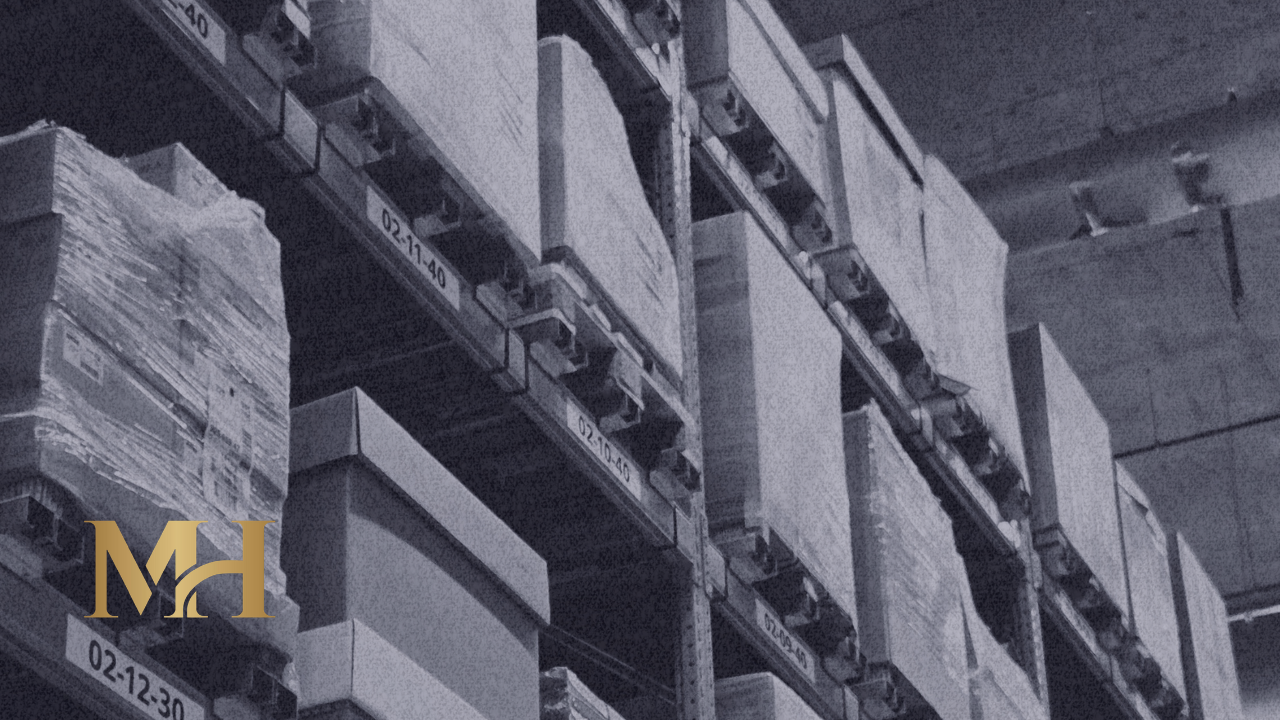
One of the most visible examples is warehouse racking.
Modern distribution facilities often use extensive steel storage systems designed to take advantage of vertical space while keeping inventory accessible to workers and equipment.
But racking is only the beginning. Steel and other metals can be found throughout the facility in:
Structural framing
Pallet racks and shelving
Conveyor systems
Mezzanines and elevated platforms
Stairs, guardrails, and safety barriers
Loading docks and dock equipment
Material-handling equipment
Automated storage and retrieval systems
Sorting and packaging machinery
HVAC, electrical, and mechanical infrastructure
The result is an interesting contradiction: the easier online shopping becomes, the more physical infrastructure may be required behind the scenes to make that convenience possible.
Faster Delivery Changed the Warehouse
E-commerce didn’t invent the warehouse. It changed what we expect warehouses to do.
When customers are willing to wait several days or weeks for an order, companies have more flexibility around where inventory is stored and how it moves.
Same-day and next-day delivery change that equation.
Inventory has to be positioned strategically. Fulfillment facilities need access to transportation networks and population centers. Orders have to move through facilities quickly. Equipment needs to handle high volumes reliably.
That has helped turn warehouse location and design into important pieces of the broader supply-chain strategy.
A distribution center is no longer simply somewhere to keep inventory.
Where it is, what happens inside it, and how quickly goods can move through it can directly affect the customer experience.
Automation Is Making Warehouses More Physical, Not Less
Warehouse automation can sound like another chapter in the story of industries becoming increasingly digital. In reality, automation still requires plenty of hardware.
Conveyor lines move packages across facilities. Automated storage systems retrieve inventory. Robotics move products between stations. Sortation systems direct packages toward their next destination. Equipment needs platforms, supports, guarding, enclosures, tracks, frames, and structural systems.
Software may tell the equipment what to do. Something physical still has to do it. That makes the growth of warehouse automation another example of a much larger trend: digital advancement often creates new demand for physical infrastructure.
Same-Day Delivery Has a Supply Chain of Its Own
A package arriving at your house the same day can feel almost instant. But before that delivery ever happens, inventory has already traveled through a much larger system that can include manufacturers, ports, railroads, trucks, distribution centers, fulfillment facilities, sorting hubs, and local delivery stations.
Each link has its own buildings, equipment, transportation needs, and material requirements.
That little cardboard box sitting on the porch represents the final few feet of a supply chain that may stretch thousands of miles. And much of the infrastructure along that journey depends on metal.
Warehouses Have Become Part of the Infrastructure of Everyday Life
Most people rarely think about warehouses unless they work in one, build one, or drive past one.
Yet they’ve quietly become an important part of how modern life functions.
The groceries ordered online, the replacement part needed tomorrow, supplies arriving at a jobsite, medical products moving through a distribution network, and the package sitting on the porch all depend on physical facilities capable of storing and moving goods efficiently.
At Metal Haven, we spend a lot of time talking about the infrastructure hiding behind everyday life because that’s where metal so often shows up.
E-commerce may happen on a screen. But getting the order to your door still takes something remarkably physical.
